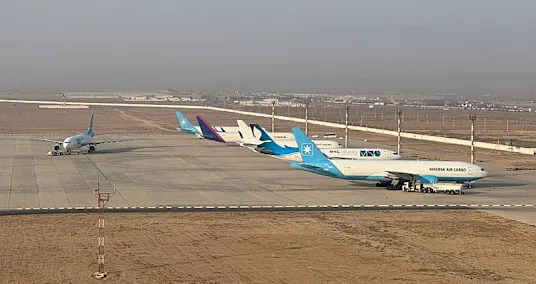
Navoi International Airport in central Uzbekistan is expanding its cargo capacity and logistics infrastructure as it seeks to attract transit flows between Europe, Asia and the Middle East, strengthening its position within international supply chains, airport officials said.
Situated along crucial transport corridors linking China with Europe and the Middle East, the airport benefits from stable flying conditions, including low humidity and limited fog, as well as proximity to industrial zones, a free economic area and established rail and road networks.
These factors support its development as a multimodal logistics platform targeting intercontinental cargo operators and freight forwarders.
“The main focus of Navoi Airport has never been passenger traffic,” said Alisher Klichev, Director of Navoi International Airport.
“Our goal is to create a central hub for cargo transit between Europe and Asia, offering seamless integration across air, road, and rail transport,” he added.

Infrastructure expansion and cargo capacity
The airport is constructing a cargo terminal covering 16,000 square metres, designed to handle general cargo, valuable and dangerous goods, e-commerce shipments, as well as postal and courier deliveries.
The facility is expected to increase handling capacity and support rising cargo volumes across Eurasian routes, particularly as demand for faster transit between Asia and Europe grows.
Fuel storage infrastructure is also being expanded. Under a 2008 presidential resolution, the airport is adding 10,000 tonnes of aviation fuel storage, bringing total capacity to 15,000 tonnes.
The upgrade is intended to support an increase in cargo flights and ensure operational continuity for long-haul freight services.
“This expansion ensures that we can meet the fuel demands of a growing number of cargo flights,” Klichev said.
Specialised operational zones are being introduced within the airport, including areas dedicated to cargo processing, express shipments, and postal and courier services.
These zones are designed to reduce turnaround times, improve cargo handling efficiency and support time-sensitive deliveries, including e-commerce shipments moving between Asia and European markets.
Related
Customs regime and integration into trade corridors
Navoi Airport operates in close coordination with the Navoi Free Economic Zone and surrounding industrial hubs, forming part of a wider logistics network that connects air, rail and road transport.
LATEST POSTS
- 1
 Africa's energy giants eye long-term gains on Iran war disruption
 - 2Scientists discover black hole flare with the light of 10 trillion suns
- 3Defense Minister Katz moves to extend IDF service to 36 months
- 4This country music star spent years hiding his sexuality. Coming out — and beating addiction — has made his soul feel '20 pounds lighter.'
- 5NATO needs Ukraine's 'adaptation DNA' and an 'HOV lane' for new war tech, top commander says




- Nearly 16,000 New York City nurses prepare to strike as contract talks stall
- New India programme supports tribal families hosting tourists
- A coup too far: Why Benin's rebel soldiers failed where others in the region succeeded
- Foods with healthy-sounding buzzwords could be hiding added sugar in plain sight
- Massachusetts court hears arguments in lawsuit alleging Meta designed apps to be addictive to kids
- Katz to Hezbollah chief Qassem: You won't live to see Israel’s full response to Passover attacks
- Best Amusement Park Bite: What Do You Very much want to Crunch On?
- James Webb Space Telescope finds strongest evidence yet for atmosphere around rocky exoplanet: 'It's really like a wet lava ball'
- From invasive species tracking to water security – what’s lost with federal funding cuts at US Climate Adaptation Science Centers