When you buy through links on our articles, Future and its syndication partners may earn a commission.

Exotic, dark astrophysical objects may be hiding in interstellar space, and a new proposal outlines how to find them: stare really, really hard.
We don't know what dark matter is, even though we strongly suspect it exists. We see circumstantial evidence for it everywhere, from the rotation rates of galaxies to the growth of the largest structures in the cosmos. For decades, cosmologists have thought dark matter is some sort of exotic particle that was previously unknown to the Standard Model of particle physics. This strange particle would not interact with light, or really much of anything else, except through its gravitational influence.
But searches for these dark matter particles have come up empty so far, driving theorists to get more creative with their ideas.
It could be that dark matter isn't made of zillions of tiny particles flying through the universe. Instead, it could be composed of bunched-up collections of much larger objects. In particular, the researchers behind a new study, published in November 2025 in the open access server arXiv, investigated two kinds of exotic objects.
The first is known as a boson star. In this model, dark matter is made of an ultra-ultra-ultra light particle — potentially millions of times lighter than neutrinos, the lightest known particles. They would be so light that their quantum nature would make them appear more like waves at galactic scales than like individual particles. But these waves would sometimes bunch up and collect on themselves, pulling together with their own gravity, without collapsing.
Another possibility is called Q-balls. In this model, dark matter isn't a particle at all but rather a quantum field that soaks all of space and time. Due to a special property of this field, it could occasionally pinch off, creating gigantic, stable, lump-like balls that wander the cosmos like a floating piece of flour in gravy that hasn't been mixed well.
Both boson stars and Q-balls, which live under the more general heading of exotic astrophysical dark objects (EADOs), are difficult to detect. They're large — roughly star-size — but they do not emit light of their own, making them nearly invisible in our scans of the cosmos.
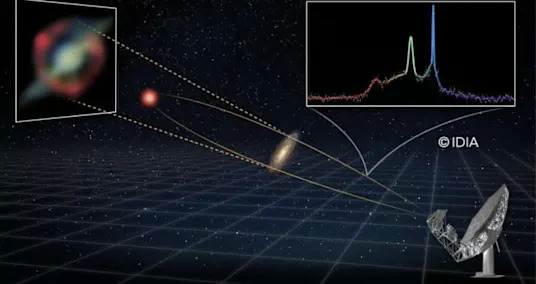
But astronomers have discovered a way that EADOs can betray their presence: microlensing. If a Q-ball or boson star were to pass between us and a distant star, the strong gravity of the EADO would cause the light from the star to act as a gravitational lens. From our perspective, it would make the star appear to suddenly jump into position and then quickly return to normal.
So all we'd have to do is stare at a whole bunch of stars for a really long time and hope we get lucky. Thankfully, we have just the instrument for the job. The Gaia space telescope's mission was to do just that: stare at a whole bunch of stars for a really long time.
The astronomers behind the study propose a campaign using Gaia data to search for Q-balls and boson stars by looking for their unique, "smoking gun" signal of sudden jumps in stellar positions. Depending on how many are out there, Gaia may have observed up to several thousand EADOs.
But if they're not out there, then this same campaign would produce stringent limits on Q-balls' and boson stars' contributions to the overall dark matter picture. No matter what, staring into the dark would teach us something.
LATEST POSTS
- 1
 Melodic Event: A Survey of \Energies and Exhibitions Assessed\ Live concert
 - 2Figuring out Significant Regulations and Guidelines for Organizations
- 3France bans Muslim gathering citing risk to participants
- 4Record-breaking 'space laser' erupts from merging galaxies 8 billion light-years away
- 5The most effective method to Augment Benefits in Gold Speculation: Systems and Tips




- 10 Hints and Deceives to Expand Cell Phone Information Use: Capitalize on Your Information
- Unpaid caregiving work can feel small and personal, but that doesn’t take away its ethical value
- Taste the World: Five Food sources That Have Dazzled Worldwide Palates
- A Gastronomic Experience in Healthy Enjoyments: A Survey of \Nutritious and Tasty\ Solid Cooking Recipe Book
- Rubble, mud and hair: How to rebuild a home in Gaza
- Ukraine Now Using Drone Boats To Attack Russian Riverine Targets
- Audits of Espresso Types: Which Mix Is for You?
- Overlooked infertility care should be part of national health services, says WHO
- The Force of Care: Living with Goal